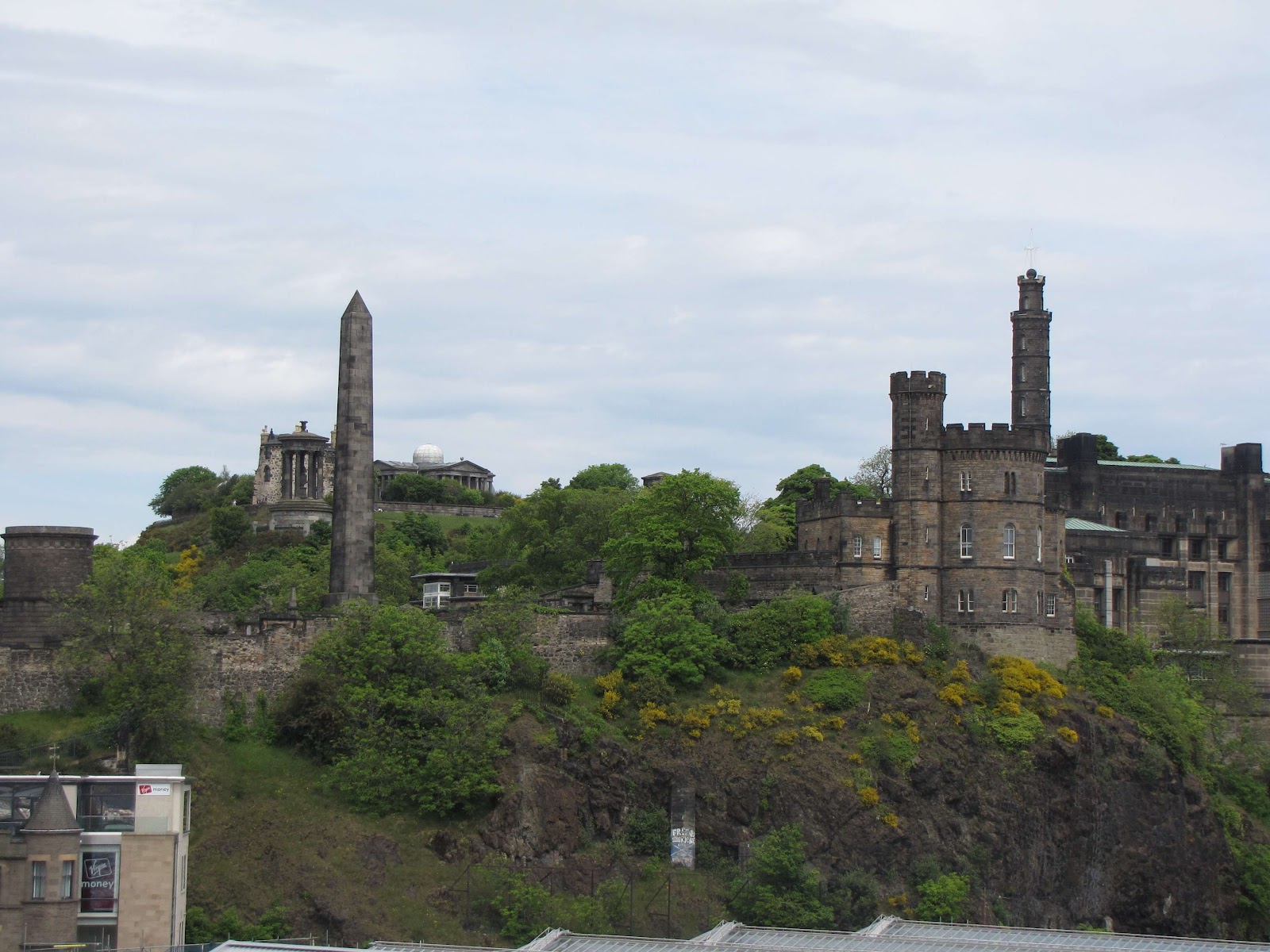
Let the games begin, time for walking about.
Shanda lives in Edinburgh near the Firth of Forth.
Firth is the word in the Lowland Scots language used to denote various coastal waters in Scotland. On mainland Scotland it is used to describe a large sea bay, or even a strait. In the Northern Isles it more usually refers to a smaller inlet. It is linguistically cognate to fjord which has a more constrained sense in English; a firth would most likely be called a fjord.
The Firth of Forth (Scottish Gaelic: Linne Foirthe) is the estuary or firth of Scotland's River Forth, where it flows into the North Sea, between Fife to the north and the City of Edinburgh to the south. See the Firth in the background of this building;
After breakfast we walked to the Scott Monument in the centre of Edinburgh; a monument to Sir Walter Scott. The Scott Monument is a Victorian Gothic monument to Scottish author Sir Walter Scott. It stands in Princes Street Gardens, near to Edinburgh Waverley Railway Station.

The tower is 200 feet 6 inches (61.11 m) high, and has a series of viewing decks reached by a series of narrow spiral staircases giving panoramic views of central Edinburgh and its surroundings. The highest viewing deck is reached by a total of 287 steps (those who climb the steps can obtain a certificate commemorating the event). It is built from Binny sandstone quarried in nearby Ecclesmachan. This oily stone was known to attract dirt quickly and was probably a deliberate choice to allow the Gothic form to quickly obtain the patina of age. Arguably the soot of Edinburgh's chimneys, in combination with smoke from the nearby railway line and Waverley Station perhaps over-egged the result, and it is now very hard to make out the numerous carved figures.
We walked all 287 steps squeezing past those that were going down, passing backpacks ahead because there was no room for a 2 people and a back pack to pass.
Charles Dickens description of the Scott Monument in 1858; 'I am sorry to report the Scott Monument a failure. It is like the spire of a Gothic church taken off and stuck in the ground.'
Leaving the monument we came upon the Santiago Calatrava Bridge in Edinburgh (peace bridge Calgary).
Then we crossed the tracks and walked past the Scotsman newspaper building to find a pub called the Waverley. Had a great lunch and watched (on TV) the Queen’s procession (part of the Diamond Jubilee) from Westminster Abbey to Buckingham Palace.
After lunch we visited the National Museum of Scotland with collections relating to Scottish antiquities, culture, history, science and technology, natural history, and world cultures. The Museum is on Chambers Street, at the intersection with the George IV Bridge, in central Edinburgh. The Museum is part of the National Museums Scotland. Admission is free.
A Dodo, looking at a bird,
A mysterious Princess,
Leaving the Museum, we strolled along and quite by accident, discovered a street monument to a small Yorkshire terrier named Greyfriars Bobby. Greyfriars Bobby was a Skye terrier who became known in 19th-century Edinburgh for spending 14 years guarding the grave of his owner, John Gray (Old Jock), until he died himself on 14 January 1872. A year later, Lady Burdett-Coutts had a statue and fountain erected at the southern end of the George IV Bridge to commemorate him.
Several books and films have been based on Bobby's life, including the novel Greyfriars Bobby (1912) by Eleanor Atkinson and the films Greyfriars Bobby (1961) and The Adventures of Greyfriars Bobby (2006).
The monument encouraged us to find Greyfriars Kirk, less than a block away and the grave of John Gray, Bobby’s owner.
Ironically, a large sign just inside the walls of the graveyard states there are no dogs allowed in the graveyard.
We then walked around Edinburgh castle. Edinburgh Castle is a fortress which dominates the skyline of the City of Edinburgh, from its position atop the volcanic Castle Rock. Human habitation of the site is dated back as far as the 9th century BC, although the nature of early settlement is unclear. There has been a royal castle here since at least the reign of David I in the 12th century, and the site continued to be a royal residence until the Union of the Crowns in 1603. From the 15th century the castle's residential role declined, and by the 17th century its principal role was as a military base with a large garrison. Its importance as a historic monument was recognised from the 19th century, and various restoration programmes have been carried out since. As one of the most important fortresses in the Kingdom of Scotland, Edinburgh Castle was involved in many historical conflicts, from the Wars of Scottish Independence in the 14th century, up to the Jacobite Rising of 1745.
Although formally owned by the Ministry of Defence, most of the castle is now in the care of Historic Scotland, and it is Scotland's most-visited paid tourist attraction.
Finally, home to dinner and rest.